
Low-voltage circuit breakers are essential for protecting electrical systems against overloads and short circuits. Air Circuit Breakers (ACBs) and Molded Case Circuit Breakers (MCCBs) are two widely used options in industrial and commercial power distribution.
Although both provide circuit protection, they are designed for different applications. Understanding their typical uses and key selection factors can help buyers choose the right solution for their distribution system.
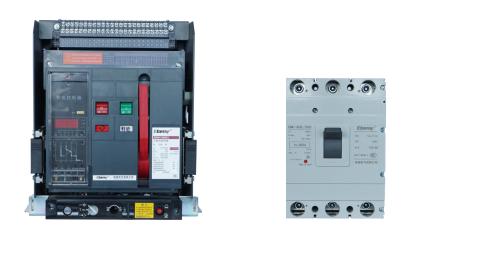
An MCCB is a compact low-voltage circuit breaker commonly used for feeder and equipment protection. It is widely used in factories, commercial buildings, machinery, and distribution panels because of its compact design and flexible installation.
An ACB uses air as the arc-extinguishing medium and is commonly used in higher-capacity low-voltage distribution systems. It is often installed as a main incoming breaker, bus coupler, or high-capacity feeder, particularly when adjustable protection and advanced control functions are required.
The main differences between ACBs and MCCBs include their construction, installation methods, protection functions, and typical applications.
ACBs are generally used for main distribution circuits where higher-capacity switching and more flexible protection settings may be required. MCCBs are more commonly used for outgoing feeders and equipment protection where a compact and practical solution is preferred.
However, their current ratings can overlap. Therefore, choosing between an ACB and an MCCB should not be based on rated current alone. The complete electrical system and protection requirements should be considered.
The choice depends mainly on the circuit's position and function within the distribution system.
For example, a factory may use an ACB as the main incoming breaker and MCCBs for production lines, machinery, HVAC systems, and other outgoing feeders. An ACB is generally suitable when the system requires higher-capacity switching, adjustable protection, or detailed coordination with downstream devices.
An MCCB is often a practical choice for individual feeders and equipment because of its compact structure and flexible installation. In many industrial and commercial systems, ACBs and MCCBs work together as different levels of the same protection system.
Before selecting a circuit breaker, buyers should confirm the system voltage, rated current, short-circuit level, protection requirements, and installation conditions.
Protection coordination is also important. The selected breaker should work properly with upstream and downstream devices so that a fault can be isolated without unnecessarily interrupting the entire facility.
For projects based on international standards, buyers should also confirm the applicable requirements of IEC 60947-2, which covers low-voltage circuit breakers.
A typical industrial distribution system may use an ACB for the main incoming power supply and MCCBs for downstream feeders. The ACB protects the main distribution circuit, while the MCCBs provide protection for individual loads and equipment.
With proper protection coordination, a fault on one outgoing feeder can be cleared by the corresponding MCCB while the rest of the distribution system remains in operation.
ACBs and MCCBs are both important components of low-voltage power distribution systems, but their typical applications are different. ACBs are commonly used for main incoming circuits, bus couplers, and higher-capacity distribution, while MCCBs are widely used for feeders and equipment protection.
The right choice should be based on the actual electrical system, including voltage, current, short-circuit level, protection requirements, installation conditions, and coordination with other protective devices.
Eberry Electric provides low-voltage and medium-voltage circuit breaker solutions for industrial and commercial power distribution applications. With experience in circuit breaker manufacturing and customized electrical solutions, Eberry Electric can support customers in selecting suitable protection equipment according to their project requirements.
Contact Eberry Electric to discuss your circuit breaker requirements.
Hak Cipta © 2025 Eberry Electric Group Semua hak dilindungi undang-undang
Situs web ini menggunakan cookie untuk memastikan Anda mendapatkan pengalaman terbaik di situs web kami.

 English
 Español
 Portugues
 Pусский
 العربية
 Türk dili
 Tiếng Việt
 қазақ
 فارسی
 українська
 беларускі
 Filipino
 o'zbek
 български
 тоҷикӣ
 kiswahili
 Монгол
 አማራ
 Ilocano



 Telepon
Komentar
(0)